The water path / Guards
Stage 03 / the honest page
No guard makes a gutter maintenance free
That sentence is the most commonly broken promise in this trade. A good guard is still worth buying. It is worth buying for what it actually does, which is not what the brochure says.
Start with the claim, because it is everywhere: never clean your gutters again. It is not true of any product on the market, it is not true of the expensive ones, and a company that leads with it has told you how the rest of the conversation is going to go.
Here is the true version. A well chosen, well fitted guard converts a miserable job into a minor one. Instead of pulling out packed, rotting, waterlogged debris twice a year, you are periodically brushing or rinsing a surface, and looking at the outlets. That is a genuine, worthwhile improvement. It is just not the same sentence as never.
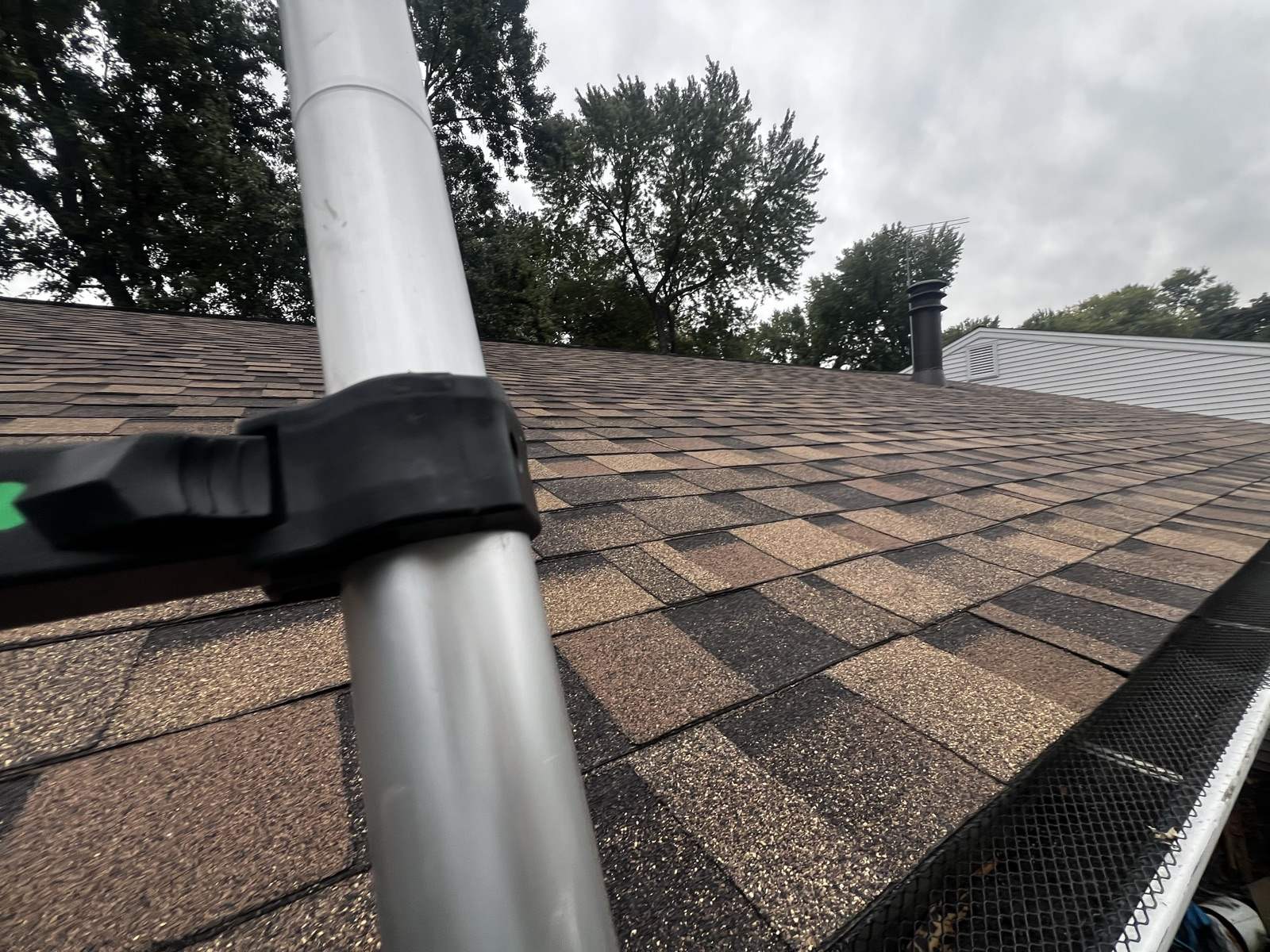
Figure 4 · The failure mode of a good guard is not leaves. It is fines: shingle granules washing off an ageing roof, pollen, roof grit and shingle dust, which are smaller than the openings are meant to stop and settle in them anyway.
What actually defeats a guard
Not leaves. Leaves are the easy case: they are large, they sit on top, and wind and rain move most of them along eventually. The problems are the small things.
Shingle granules and roof grit. An asphalt roof sheds mineral granules for its whole life and sheds them heavily in the first year and again as it ages out. Those granules are sand-sized. They do not sit on top of a micro-mesh, they settle into it, and a screen with its openings full of grit is not a screen any more, it is a lid. This is why a guard installed over an old roof frequently disappoints, and why it is worth fitting guards after a roof replacement rather than the year before one.
Pollen and seed. Spring in St. Louis puts an extraordinary amount of fine organic material on every horizontal surface. Maple seed, oak catkins and pine needles are particularly good at threading into or lying across mesh openings.
Shingle dust and tar. Fine dark material washing off an ageing roof binds the grit into a mat, which is the point where a screen stops passing water even though it looks reasonably clean from the ground.
The types, briefly and without favouritism
- Simple screens and drop-in mesh. Cheap, easy, keep out large leaves and squirrels. Coarse enough that fine material goes straight through into the trough, so you are still cleaning, just less often. Also the type most likely to blow out or lift under a hard rain if it is only resting in the trough.
- Micro-mesh over a frame. The type most worth having and the type most oversold. Very effective on leaves and needles. Vulnerable to blinding by grit and pollen as described above. Fitting matters enormously: the mesh has to be supported and pitched so water sheets off rather than pooling on it.
- Reverse curve or surface tension. Relies on water clinging around a curved nose while debris falls off the front. Works when it works. In very heavy rain, which is precisely the condition you care about, water arriving fast off a steep roof can overshoot the nose entirely. Also tends to be visible from the ground.
- Foam and brush inserts. Cheap, no fixings, and they do keep leaves out of the trough. They also hold moisture and collect fine sediment inside themselves, and pulling a saturated foam insert out of forty feet of gutter is not a better afternoon than cleaning the gutter was.
Say the unflattering thing
Three situations where we will tell you not to buy guards
Your roof is near the end of its life. Fitting guards now means fitting them into the heaviest granule loss the roof will ever produce, and then disturbing or removing them when the roof is replaced. Wait.
Your gutter is undersized or sagging. A guard does not add capacity and it does not add fall. It will make an overflowing gutter overflow with a screen on it, and now you cannot see into the trough to work out why. Fix the geometry first. Sizing, then pitch.
You have no trees. It happens. If nothing overhangs the house, the annual load is grit and pollen, which is the exact material guards are worst at, and a rinse once a year is cheaper than a guard system by a wide margin.
What good fitting looks like
The guard has to be secured so it cannot lift in wind or under a slug of water. It has to sit so that water running off the shingle lands on the guard and not behind it, because a guard that lets water get behind the gutter is worse than no guard at all. Where it meets the roof it must not be tucked so far under the shingles that it lifts the course above, which is a genuinely common installation fault and one that causes roof problems rather than gutter ones. And the outlets need to stay reachable, because when something does eventually block, it blocks at the outlet.
What to ask whoever is quoting you
Ask what happens when it does clog, and who comes. Ask whether the guard is fastened to the gutter or to the roof, and if it is going under the shingles, ask exactly how far. Ask what the maintenance is, in plain words, and be suspicious of the answer none. Ask how old your roof is, and if they do not know or do not ask, they are not thinking about granules.
Keys fits guards. Keys will also tell you when a guard is the wrong purchase for your house this year, which is a conversation that costs us a sale and saves you one.
Next step
Have someone look at the run before you buy anything
Whether a guard makes sense on your house depends on the trees over it, the age of the roof above it and the condition of the trough it would sit in. Keys Roofing does roofing, gutters and downspouts, and nothing else. Call (314) 220-2333 or use the callback form on the front page.
Ask before you buy a guard
Tell us what is actually landing in the gutter
Needles, seed pods, shingle grit and maple keys each defeat a different screen, so the useful message names the trees standing over your house rather than the product you were about to buy.
If the honest answer is that a guard will not fix the problem you have, that is the answer you will get, and it costs us the sale.
Straight through to the Keys office. Roofing, gutters and downspouts only, across greater St. Louis.