The water path / Sizing
Stage 03 and 04 / capacity
Five inch or six inch, and why the downspout matters more than the trough
If your gutters overshoot in a hard rain and they are clean, stop buying cleanings. You have a capacity problem, and capacity is mostly decided at the outlet.
There is a conversation that happens on ladders in this town several times a week. The homeowner says the gutters are clogged again. The gutters are not clogged. They were cleaned in October, it is April, and there is nothing in them but a film of grit. And in a serious storm they still throw a sheet of water over the front edge onto the walk.
That house does not have a cleaning problem. It has a roof that sheds more water per minute than the gutter system can carry away, and no amount of cleaning changes the arithmetic.
What actually decides the size
Three things, in roughly this order of importance.
The roof area feeding the run. Not the whole roof: the area that drains into that particular length of gutter. A single gutter run on the low side of a big rear slope may be catching more water than the entire front of the house.
The pitch of the roof above it. A steep roof does not collect more rain, it delivers the same rain faster and with more momentum. That is why steep roofs overshoot. Water arriving at speed wants to keep going in a straight line, right over the front lip of the trough, and it will do that in a perfectly clean gutter.
How many outlets the run can be given. This is the one that gets ignored. A forty foot run with a single downspout at one end has to move everything through one throat. The same run with an outlet at each end halves the distance water has to travel and doubles the throat. Adding an outlet is frequently cheaper than replacing the gutter and does more.
Figure 1 · The two downspout rectangles are drawn to the same scale. Two by three is six square inches of opening. Three by four is twelve. That part is not an estimate, it is multiplication, and it is the single biggest lever on how fast a gutter empties.
The numbers you can check yourself
A two by three inch downspout is six square inches of opening. A three by four is twelve. That is straightforward multiplication and it is the least arguable number in this whole trade. Doubling the opening does not exactly double the flow, because friction and the shape of the outlet matter too, but it is close enough that the rule of thumb holds: going from two by three to three by four gets you into a different class of system.
The trough itself gains less than people expect. A five inch K-style is somewhere around seven and a half square inches of cross section and a six inch is around eleven, so you are buying something between a third and a half more capacity depending on the exact profile, not double. Useful, but the reason six inch matters is mostly that a six inch trough accepts the three by four outlet cleanly. The trough is the queue. The outlet is the door.
Say the unflattering thing
Six inch is not an upgrade, it is a specification
On a modest ranch with a shallow roof and short runs, six inch gutter is capacity you will never use, on a heavier profile that will look wrong on the fascia, for more money. We will tell you that. The houses that genuinely need it are the ones with large steep planes, long runs, deep valleys dumping into a single point, or a two-storey wall where an upper roof discharges onto a lower gutter.
The upper roof onto the lower gutter problem
This one is worth its own paragraph because it is common in St. Louis and it is rarely handled. Plenty of houses here have a second storey whose downspout, or whose roof edge, discharges onto a first storey roof. That lower roof then has to carry its own rainfall plus everything from above, all of it arriving at one spot. The lower gutter under that spot is being asked to do several times the work of the gutter ten feet away, and it will fail while everything around it is fine.
The fix is not always a bigger gutter. Sometimes it is running the upper downspout down the wall and past the lower roof entirely, or adding an outlet directly under the impact point. That is a look-at-the-house decision.
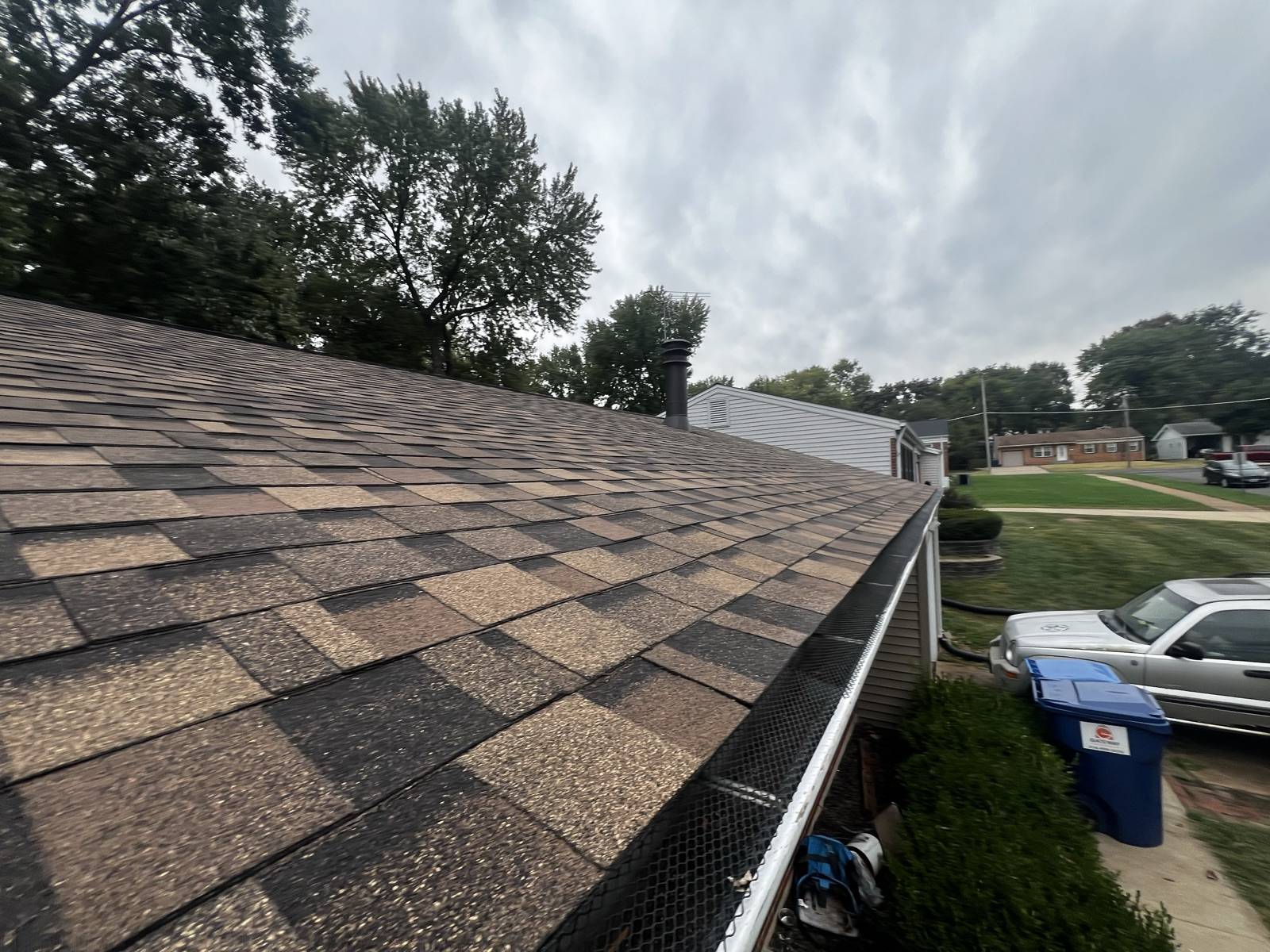
How to tell which problem you have
- It overflows everywhere along the run, in every storm, and it is clean. Undersized, or not enough outlets. More cleaning will not help.
- It overflows in one spot only. Look up. There is probably a valley or an upper discharge landing there.
- It overflows only in the heaviest rain of the year. That may be acceptable. Every gutter has a rate it cannot beat, and designing for the single worst cloudburst in a decade is not always money well spent.
- It holds water after the rain stops. That is pitch or sag, not size. Different page.
- It overflows behind the gutter, against the fascia. That is usually a drip edge or flashing detail at the roof edge, not the gutter at all.
What we do about it
Keys forms seamless gutter on site, so the run is sized to the house rather than to whatever comes in ten foot lengths. Where a run is undersized we will say whether the honest fix is a larger profile, a larger downspout, an extra outlet, or a combination, and we will tell you when the cheap option is the right one. Then the water has to go somewhere, which is the next question and the one most companies stop asking.
Next step
Have someone look at the run before you buy anything
Sizing cannot be settled from a photograph or a phone call, because it depends on the area draining into a particular run and on where the outlets can physically go. Keys Roofing does roofing, gutters and downspouts, and nothing else. Call (314) 220-2333 or use the callback form on the front page.
Ask about sizing
How many outlets does that elevation actually have
Tell us roughly how many downspouts serve the side that overflows, and whether the water comes over the front lip or behind the back of the trough. That alone usually separates a sizing problem from a pitch problem before anyone puts up a ladder.
Often the fix is one more outlet rather than a whole new run, and that is a much smaller invoice than the one you were bracing for.
Straight through to the Keys office. Roofing, gutters and downspouts only, across greater St. Louis.